Showing posts sorted by relevance for query color. Sort by date Show all posts

Sunday, June 17, 2012

The Colors of Hot Springs

Tea-colored Hot Spring on Seaside Hotel Roof
Bone white, emerald green, muddy gray, tea brown, dark black, and rust red are some colors that I have enjoyed in hot springs. The variety of colors is just one of many aspects of hot springs in Japan to appreciate in the same manner that wine experts do with the color of a glass of wine.  Connoisseurs of hot spring water close their eyes and focus their other senses on the consistency, the smell, and the feel of the water on the skin. After drying off, another consideration is the "after-feel" or lingering change to one's skin. What I call the after-feel could be a marked increase in smoothness, a slight stickiness, or softness.

A Lovely Light-green Hot Spring Effusing Calmness

What causes color differences? The answer my friend is the concentration of minerals and other solid materials floating or flowing in the water. For a more scientific explanation, dive into the Water Encyclopedia.

A Clear Colored Indoor Public Hot Spring in Beppu for 100 yen!

The Japanese hot spring world was rocked about ten years ago when the Shirohone 白骨 Onsen 温泉 controversy. Shirohone means "white bone" in Japanese. The color of the water is similar to that of milk ice cream. The edges of many of the baths in the village of Shirohone, Nagano Prefecture, are encrusted with years of accumulated minerals; many say that the hardened mineral formations resemble bones. 

Hot spring water deep in the earth had absorbed whitish minerals, but the minerals were naturally decreasing in some of the springs in town, so the water was losing its distinctive color at some onsen hotels.  Some locals decided to obtain minerals from another area of Japan and mix them with the local waters, but that is just not proper behavior in Japan. 


White Sulfur Bath in Beppu

Onsen purists were boiling mad, steamed up, in a sweat, and they raised hell, bringing this matter to the media's attention.  Business declined in the area until time passed and most people forgot about this issue. The hot spring controversy became a lot of hot water that flowed under a bridge. Okay, I promise I will not write any more mixed metaphors, but I will, in another post, write about mixed bathing. For the record, though, I highly recommend visiting Shirohone because of its secluded natural feeling, lovely views from outdoor baths near rustic buildings, and excellent local cuisine.

Saturday, September 18, 2021

Japan's Best Natural Hot Spring Waterfall

Imagine the plunging cascades of a thermally heated twenty-meter-high waterfall massaging your neck, shoulders, and back. Kawarageoyu-taki is the name of this remote natural entry-free onsen in Takamatsu National Forest, Yuzawa City, Akita, that soothes the body and  soul. To experience idyllic forest bathing, come here. 


Thermal waterfalls are rare even for Japan, which boasts over 3,000 onsen areas and approximately 27,000 individual bathing locations. In my quest for the perfect bath, I have found only four such waterfalls. Kawarageoyu-taki is definitely the best.


Kawarageoyu-taki is special for many reasons. Located in Takamatsu National Forest, Yuzawa City, Akita Prefecture, admission is free to anyone willing to take the 10-15 minute hike from the parking space. The lovely path will introduce you to sights that you have probably never seen before. 


First, you'll see a stream of hot water and steam wafting the sweet smell of sulfur. Proceed down the hiking trail and you'll cross over the stream via a small wooden bridge. Unfortunately, the trail is not accessible for wheelchair travelers.


As you walk over the stream of hot water, notice its clarity and green color, which could be from alkaline minerals or algae or a combination. Depending on the season and weather, the temperature of the stream leading to the waterfall varies. At the time of my summer visit, the stream temperature was about 50 Celsius or 122 Fahrenheit.

\
If you are lucky, the trees will frame the waterfall with their branches.
 

Soon, you'll be at the pool, marveling at the color, the aroma, and the bathing opportunities. Choose from standing or sitting under two of the main cascades or settle yourself into a number of naturally formed pools. The hot water is chest-high in the deepest pools. My suggestion is to try them all! When we visited, there were only two other people, and they soon left. Most people wear clothes while bathing here, but one old man who arrived just before I left bathed naked except for the traditional tiny towel for covering his privates. The wooden stairs seen in the photograph above lead to basic changing rooms.


To have the best experience, which to me means fewer people, go in the morning and on weekdays. Avoid holidays. I took a photograph of an image on a sign at the entrance to the waterfall. Compare that image below with mine. Also, you might think that soaking in this hot spring during winter or early spring while the surrounding environment is snowy or cold would be a wonderful experience, but that is a mistake. I once visited during the spring season and was disappointed because the waterfall's temperature was cool. That was because the melting snows had released cold water that flowed into the thermally heated stream. My visit in early September was heavenly. I estimated the water temperature at slightly above 40 Celsius (104 Fahrenheit). The Japanese autumn, with its exploding golden foliage, must be fantastic.  Winter might prevent challenges as Akita receives heavy snowfall.

Kawarageoyu-taki is one of many extraordinary attractions located in Akita prefecture's Yuzawa Geopark.  Click on the link and see what else interests you. 


Saturday, June 7, 2025

Beautiful Indoor and Outdoor Private and Public Onsen Baths at Resonate Club Kuju


To experience indoor and outdoor baths offering expansive vistas in a mountainous setting, come soak at Resonate Club Kuju. It is a unique resort at an elevation of 860 meters in the Aso-Kuju National Park in Kyushu, Japan. Daytrippers and overnighters are welcome. 

The resort offers a variety of accommodations, ranging from rooms that combine Japanese and Western comforts to geodesic dome glamping, situated amidst lush grasslands and rolling hills.

The interior of the glamping accommodation
Front view of one of the glamping domes

The first bath of my stay was an evening immersion in one of the kashikiriburus, meaning private baths. These baths can be reserved for one-hour intervals. Although I am crazy about almost all styles of bathing in Japan, there are times when I enjoy being alone. This was one of those times. Kashikiriburos are a perfect solution for couples or families who are uncomfortable bathing in the nude with strangers. Private baths are also helpful for tattooed individuals who might not be allowed to enter the communal baths. 

The color of mineral water filling the private baths indicates a high concentration of iron


That night, I had the pleasure of staying in one of the glamping tents, a few minutes uphill from the main resort building and bathing areas. Located far from cities and busy roads, the night was aflame with energetic stars. Walking to the kashikiriburo, I felt the coolness of the high-altitude location, so I hurriedly entered the indoor bath, which chased the chill away. Then, I went outside and lay in the shallow outdoor bath with my head pointed to the inky black sky awash with sparkling pin pricks of brilliant stars. A cold breeze teased the exposed parts of my body, but the naturally flowing hot mineral water kept my body relaxed as the sky provided a mesmerizing show. The water is thick with soothing minerals. The heat seems to stay in your body long after leaving the baths. You'll likely have a long, deep sleep in the evening. I did. 

Notice the crystallization of minerals in the bath water

The next morning, I woke up to views that made me pop out of bed. After a nice roasty cup of freshly ground and brewed coffee, I walked back to the resort to consume an extensive buffet breakfast of Japanese and Western dishes. 

Morning view from my luxurious tent

Sated and feeling good, I decided to enter the communal baths before departing. The timing was perfect. Since most other guests had checked out early. I had the community baths all to myself.

Sunrise plus hot water equals happiness

The sun poured through expansive windows surrounding the indoor bath. I could sunbathe and waterbathe. 


Steam and sky reflections

Getting There: This onsen resort is remote, so I suggest renting a car. Keep in mind that there are no restaurants or convenience stores nearby. You will be surrounded by grassy fields, trees, mountains, and vast vistas. 

Activities: If you like being outdoors, fresh air, and exercise, this is the place for you. Horseback riding, hiking, bicycling, and all sorts of other outdoor sports, including tandem paragliding, are available in the national park. For more information on what you can see and do in the vicinity, click here. I suggest viewing one of Japan's best taiko groups perform in an outdoor theater on a mountain plateau. Drum Tao is a mindblowing, creative, and energizing Japanese group of drummers and dancers. 

More nearby Japanese onsens: 


Japanese contact information for the resort: 

878-0202 大分県竹田市久住町大字有氏1773   TEL.0974-76-1223 FAX.0974-76-1460


English contact information for the resort:


Monday, May 29, 2017

Meeting Extraordinary People in Japanese Hot Springs


When naked in a hot spring, the layers of clothing that display our pretensions, our fashion statements, and our barriers no longer separate our bare selves from others. In a shared hot spring bath, with the right people and the right timing,  connections develop between strangers. The Japanese refer to this bathing phenomenon as hadaka no tsukiai, often translated as naked communion or naked friendship.

My Swiss friend and I, an American ex-pat in Japan,  experienced hadaka no tsukiai at Ogi Onsen Hot Spring Ryokan Kamemeso. First, we soaked by ourselves in the rock-lined indoor bath. Spacing out, I noticed patterns in the wooden walls that were stained by years of daily exposure to mineral-laden steam drifting toward the high wooden ceiling. Through wet windows, I could see four Japanese men in their twenties laughing and chatting in the rotenburu, outdoor bath. Not long later after flushing the stress out of my body and soul in a sweaty but cleansing indoor sauna, I wandered outside where my Swiss friend was smiling and chatting with two of the young men. I joined them. Above the bath, the heavens were cloudy and dark. Inside the illuminated bath, a current of friendship was circulating. Chatting, I learned that one muscular young man with natural black hair dyed lighter than mine was a professional dancer. His friend said that he was famous. I asked if I could take a photograph. He reached behind him and lifted a prosthesis for his lower left leg. He waved it in the air with gusto. He was brimming with confidence, the kind that comes from overcoming great odds and becoming a public figure. His name is Koichi Omae. Koichi san, representing Japan,  danced at the closing ceremonies of the Rio Paralympic Games.

Koichi was in Sadogashima (Sado Island, Niigata) to rehearse with members of Kodo, Japan's foremost taiko (Japanese percussion) group. Their performance was scheduled for two days later in Tokyo. We talked for a while about dancing and his injury. Koichi told me that his lower leg had been severed after a car struck him while he was taking a walk. Koichi also shared that representing Japan was stressful. Despite the hardships, by dint of hard work and practice, sometimes seven hours a day, he had overcome an incident that would have devastated most people. He truly is an amazing young man. I googled Koichi Omae and found two spectacular online videos. The first shows a graceful but powerful classical ballet style solo dance. The second video displays a more upbeat and acrobatic performance of Koichi drumming on his wheelchair, then dancing with it while slipping between  Kodo members as they beat their instruments.I am looking forward to attending a future dance performance by Koichi, Omae, an extraordinarily talented young man.
Photo provided by Earth Celebration Committee
Hot springs are doors to perception. In Japanese onsens, I have met many interesting people–politicians, yakuza, policemen, hot spring designers, painters, and more. These were colorful characters that I  would never have met if not for my hot spring addiction. Through getting naked in hot springs, I have gained insights into Japanese culture. Most of my experiences have been wonderful, but, to be honest, I have met a small number of weird people.

Ogi  Onsen Ryokan Kamemeso is a short walk from Ogi Port, Sado Island. Sado Island is Japan's sixth largest island. Despite having lovely mountains, picturesque beaches, superb seafood, rice, and vegetables, and a wealth of unique cultural attractions, Sado Island gets few visitors. Ferries leave from Myoko, Niigata, arrive in Ogi Port. Ferries from Niigata City bring visitors to the main port city of Ryotsu. Buses cross from Ryotsu to Ogi Port.

Bathing at Ogi  Onsen Ryokan Kamemeso was a delightful experience that I had almost passed up. The exterior of the building is a garish yellow color that gives a false impression to visitors. My friends hesitated to enter, but I convinced them to give it a try after looking at the interior. The inside is clean and artistically decorated with local paintings. You can stay overnight or just visit for a bath for 420 yen per person. Since I did not stay overnight, I cannot comment on the rooms. Click to see their website.

Thanks for reading. Please read other posts, and make comments.


Friday, October 23, 2020

Waterfalls, Autumn Leaves, and the Beautiful Baths of Oigami Onsen, Gunma

 
We are entering the season of fiery colors, powerful waterfalls, and hot baths with spectacular views. Grab your towel and make travel plans for the gorgeous mountains if you're in Japan. Those outside Japan will have to wait and salivate.
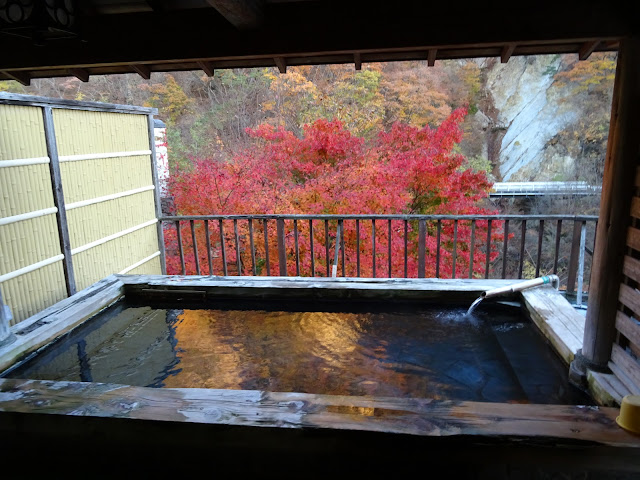
A friend told me that he wanted to enjoy fall in a relaxing and rustic area of Japan, where mass tourism had not changed the locals. I recommended Oigami Onsen in Numata, Gunma. Even before the pandemic, Oigami did not get much traffic despite the presence of one of the most unique and graceful waterfalls in Japan, small markets where you can meet the artists and vegetable growers, and rare festivals.  


Fukiware Falls is the name of this unusual waterfall. Ware means crack in Japanese. The river suddenly plunges into a 7-meter-deep and 30-meter-wide crack in the riverbed.  This river, bursting with colors in fall, was designated as a natural heritage spot for its beauty, and the waterfall is listed as one of Japan's one hundred top waterfalls.     

Walking and hiking trails of various difficulty levels (nothing particularly strenuous) and a small bridge take visitors to numerous breathtaking viewpoints. The river changes color depending on the angle of your view, sunlight, and water depth.
The path to the the trail heading to the falls leads through a small market evocative of Japan's countryside fifty years or so ago. The aromas of roasted salted and bamboo-skewered river fish, baked sweet potatoes, and hot amazake waft along the walkway. Traditional woven baskets, wooden dolls, and antiques are on sale, as are various wild mushrooms that might have been gathered that morning in the nearby mountains.


The main street (it is tiny) with hotels and ryokans in Oigami Onsen is a six-minute drive from Fukiware Falls. One can walk, as well. The accommodations in Oigami tend to be along the side of the river. Some are closed. Sleepy Oigami Onsen is far off the golden route of tourism in Japan. Walking along the small-town streets and the riverside are cures for stress. You'll discover another small market, tiny shrines and temples, and a mischievous supernatural being with a giant nose. His name is Tengu.


During our short sojourn in Oigami, we stayed at the mid-range Yamaguchiya Hotel. Built on the rim of a high riverbank, views from the public hot bath and most of the rooms were picturesque. Ingredients for dinner and breakfast meals were mostly locally procured fish, mushrooms, pickles, and vegetables. The building could use a bit more maintenance, but since this area of Japan does not get many tourists, probably a large number of businesses in the area are just holding on. The hotel's highlights were soaking in the bath while enjoying a wide view of rivers, cliffs, and autumn leaves. And the service provided in this mid-range hotel was as fine as that shown to guests at first-class hotels.


During one of our walks through the small town, we discovered a 108.22 m (355 ft) snake. It was holding bottles of local sake in its mouth. This snake is the one that the Guinness Book of World Records had certified as the longest festival snake in the world.


Legend has it that the waterfall was discovered by someone who saw a giant snake in the river. One of Nemuta city's webpages gives the following information:

"On May 3rd, a giant snake float weighing two tons and stretching to a length of 108 meters is brought out from its holding place at the Akagi shrine. On the 7th and 8th, 200 participants in the festival hoist the snake into the air and parade it around the streets. Adventurous souls are always welcome to join in."

I recommend Oigami Onsen to all readers seeking a relaxing time in a sleepy town surrounded by the earthy fiery colors of the Japanese autumn.

Wednesday, February 26, 2014

Best Hot Spring in Asakusa, Tokyo

 Mt. Fuji is visible from the indoor bath of Jakotsuyu (蛇骨湯), my favorite thermal oasis in Asakusa, Tokyo. Taking a hot bath can help you maintain your mental health when dealing with the cacophony and visual-sensory overload of over 13 million people in the crowded Tokyo metropolis.
Mt. Fuji Wall Mural
Refresh yourself in Tokyo's "hidden hot springs,"and then jump back into the crowds and explore one of the most vibrant cities on Earth.
Mt. Fuji is visible from the indoor bath! Actually, the view is an intricate and beautifully created ceramic-tile mural of Mt. Fuji that was created by an artist who specializes in decorating public baths. The mural is reminiscent of Edo period art, and rightly so, for the hot spring has been a part of Tokyo life since the Edo period. However, the modernized facilities are spotlessly cleaned by the family who owns and manages the hot spring. You will probably meet at least one member of the family working at the front or walking about the facility.
Senso-ji in Autumn
In Japan, female staff members sometimes walk into the men's section for cleaning or replacing towels. They usually do their business and quickly leave. I was surprised when I walked into the men's area to find fully-clothed women standing and casually chatting with naked guests and semi-naked customers in the process of dressing or disrobing. A customer called one of the women "Mama-san." She is one of the owners. No one seemed to feel that the presence of the two ladies was out of place. This attitude is a part of Japanese onsen culture that may surprise many foreigners. I find that it adds color to the experience.
Crowded Senso-ji
There are several, unknown to most tourists, hot springs near the renowned, historical area of Asakusa. Asakusa is the home of a famous Buddhist temple called Senso-ji, which attracts 30 million visitors every year. Going there is a goal of many visitors to Tokyo. Senso-ji is absolutely worth visiting, but do not forget to visit at least one of the local hot springs. Through your bathing experiences, you will learn more about Japanese culture.
Door to the Outside Bath, Rotenburo
Jakotsuyu is very easy for the hot-spring-uninitiated visitor. A bilingual vending machine stands at the entrance doling out admission tickets (450 yen or about US $4.50) and coupons for small towels, large towels, soap, shampoo, combs, and many other toiletries. All items and prices were marked in English and Japanese.
The Almost Hidden Entrance to Jokotsuyu
Although, the onsen is in the middle of a busy entertainment area with restaurants, neon lights, homeless people, and drinking establishments, the owners designed the interior of the bathing rooms so that you feel that you are no longer in Tokyo. You could be at a small community bath in rural Japan.

The onsen has an electric bath, a muscle-pounding jet bath, a sauna, an indoor bath, and a bath that is in sheltered location, yet exposed to the outside air. I give the owners a big hand for installing a small koi (Japanese carp) pond next to the outdoor bath. Cooling down in the cold fresh air while watching the slowly moving gold, orange, and red fish is another soothing experience.

The mineral-laden hot water has a brown tinge to it, and it feels very smooth on the skin. When I walked out of the onsen and back into the evening atmosphere of Asakusa, I felt cleaner and calmer than I did before entering. Such is the magic of a good hot spring!

Be aware fellow hot spring addicts that Jakotsuyu is closed on Tuesdays. It is open from one in the afternoon until midnight.

Getting There: Jokotsuyuu is within a short walk of Exit A1 of the Toei Asakusa Station, and Exit 3 of the Tokyo Metro Tawaramachi Station. However, since it is located in a small alley, finding it can be difficult. If you become lost, show the name and address to a local. The address in English is Taito-ku Asakusa 1-11-11. The Japanese address is 東京都台東区浅草1-11-11. The phone number is 03-3841-8645, and the web address is http://www.jakotsuyu.co.jp/