Showing posts sorted by date for query color. Sort by relevance Show all posts

Friday, November 7, 2025

Japan's Only World Heritage Hot Spring: Wakayama Prefecture's Tsuboyu

An ancient onsen bath called Tsuboyu is the only Japanese hot spring listed by the United Nations Educational, Scientific, and Cultural Organization (UNESCO) as a  World Heritage Site. With thousands of years of spirituality tied to water, many Japanese onsens are awash with antiquity. At Tsuboyu, you can soak in traditions that exist nowhere else. 

For centuries, pilgrims have performed ablutions here, and so can you. Photo courtesy of Wakayama Prefecture Tourism

Location
Tsuboyu Onsen is located in a remote, tiny village called Yunomine Onsen (onsen can refer to a bath, a bathing facility, or a municipality with various bathing locations), which has a small number of inns and unique hot springs.  The Tanabe City Kumano Tourism Bureau webpage states that "Yunomine Onsen was discovered about 1,800 years ago, and is thought to be one of the oldest hot springs in Japan." Yunomine Onsen is in a valley within the Kii Mountain Range, home to unique pilgrimage trails, shrines and temples, and springs of great antiquity. The region's significant locations comprise the Cultural World Heritage Site, officially named Sacred Sites and Pilgrimage Routes in the Kii Mountain Range. 

Trail sign for one of the numerous pilgrimage routes

Justification for Registration as a World Heritage Site
UNESCO explains its decision to accept Japan's request for the area to be listed as a World Heritage Site for the following reasons, stated on a UNESCO webpage:

Outstanding Universal Value Brief synthesis  

Set in the dense forests of the Kii Mountains on a peninsula in the southernmost part of mainland Japan, overlooking the Pacific Ocean, three sacred sites – Yoshino and Omine, Kumano Sanzan, and Koyasan – are linked by pilgrimage routes to the ancient capital cities of Nara and Kyoto. Together these sites, the connecting pilgrimage routes, and surrounding forests form a cultural landscape that reflect the fusion of Shintoism, rooted in the ancient tradition of nature worship in Japan, and Buddhism, which was introduced from China and the Korean Peninsula. The sacred sites are connected by 307 km of pilgrimage routes which cover a total area of 506.4 ha. With the surrounding forest landscape, they reflect a persistent and extraordinarily well-documented tradition of sacred mountains maintained over 1,200 years.

Criterion (ii) :The monuments and sites that form the cultural landscape of the Kii Mountains are a unique fusion between Shintoism and Buddhism that illustrates the interchange and development of religious cultures in East Asia.

Criterion (iii) :The Shinto shrines and Buddhist temples in the Kii Mountains, and their associated rituals, bear exceptional testimony to the development of Japan’s religious culture over more than a thousand years.

Criterion (iv) : The Kii Mountains have become the setting for the creation of unique forms of shrine and temple buildings which have had a profound influence on the building of temples and shrines elsewhere in Japan.

Criterion (vi) : Together, the sites and the forest landscape of the Kii Mountains reflect a persistent and extraordinarily well-documented tradition of sacred mountains over the past 1,200 years."

How does bathing in Tsuboyu feel?                                                                                        


For someone whose favorite aspect of Japan is its bathing culture, I was thrilled to bathe in the same tiny, earth-heated bathing spot that thousands of people have used over the course of thousands of years. I could (I know it is psychological) sense the history. For many Christians, Muslims, Jews, Buddhists, and others, entering sacred churches, mosques, synagogues, and temples is uplifting. That was how entering Tsuboyu felt for me.

Looking up at the roof above the spring

Getting close to nature is a spiritual experience for me, and this "bathtub" was natural. It is like a tiny cave in the ground surrounded by a basic wooden hut. The oval-shaped bath was carved into rock alongside a creek. Bathers rest upon a layer of heated rock and gravel. My toes felt hot water seeping through the gravelly rock as I stared upward at the rustic wooden ceiling. The bath would be perfect for one person and a little tight for two people, unless the two are intimately related. Three people can enter at once, but I do not recommend it. If the natural temperature is too hot, you can add some cool tap water. The water reportedly changes color with temperature and lighting differences, but when I was there, it was clear with a slight sulfur aroma.

Outside historic Tsuboyu Onsen

The history and location attract numerous visitors. To ensure visitors have a chance to bathe, bath time is limited to 30 minutes per party. Yunomine Onsen village is small, so finding the ticket booth is quick and easy. Pay 800 yen for an adult and 400 yen for a child. You will be given a number and an estimate of how much time you will have to wait. Many visitors spend less than the allotted 30 minutes soaking. While waiting, you can relax in a small shack by the bath entrance, and you might see hikers or pilgrims ascending or descending the Kumano Kodo hiking trail that passes by Tsubonoyu.

Yunomine Onsen has other bathing areas that are worth visiting. Unfortunately, I had a long journey back home and could not stay as long as I wanted, meaning I will return to try out the other baths in this mysterious area of Wakayama Prefecture, Japan. 

For directions and more information on the three public baths, a hot spring used for cooking, and the lodges with in-house onsens, examine this useful webpage prepared by the Tanabe City Kumano Tourism Bureau.

If you are interested in bathing in one of the best cave baths in Japan, please read the following post about a hotel facility also located in Wakayama Prefecture.

Onsen (Hot Spring) Addict in Japan: Beautiful Japanese Onsen Baths in Seaside Caves

This post introduces a riverside hot spring in a town famous for traditional river rafting experiences. Onsen (Hot Spring) Addict in Japan: Riverside Onsen in Remote Kitayama, Wakayama: おくとろ温泉 やまのやど Okutoro Onsen Yamanoyado

Please write something in the comment field if you want to ask questions or recommend onsens. 


Saturday, June 7, 2025

Beautiful Indoor and Outdoor Private and Public Onsen Baths at Resonate Club Kuju


To experience indoor and outdoor baths offering expansive vistas in a mountainous setting, come soak at Resonate Club Kuju. It is a unique resort at an elevation of 860 meters in the Aso-Kuju National Park in Kyushu, Japan. Daytrippers and overnighters are welcome. 

The resort offers a variety of accommodations, ranging from rooms that combine Japanese and Western comforts to geodesic dome glamping, situated amidst lush grasslands and rolling hills.

The interior of the glamping accommodation
Front view of one of the glamping domes

The first bath of my stay was an evening immersion in one of the kashikiriburus, meaning private baths. These baths can be reserved for one-hour intervals. Although I am crazy about almost all styles of bathing in Japan, there are times when I enjoy being alone. This was one of those times. Kashikiriburos are a perfect solution for couples or families who are uncomfortable bathing in the nude with strangers. Private baths are also helpful for tattooed individuals who might not be allowed to enter the communal baths. 

The color of mineral water filling the private baths indicates a high concentration of iron


That night, I had the pleasure of staying in one of the glamping tents, a few minutes uphill from the main resort building and bathing areas. Located far from cities and busy roads, the night was aflame with energetic stars. Walking to the kashikiriburo, I felt the coolness of the high-altitude location, so I hurriedly entered the indoor bath, which chased the chill away. Then, I went outside and lay in the shallow outdoor bath with my head pointed to the inky black sky awash with sparkling pin pricks of brilliant stars. A cold breeze teased the exposed parts of my body, but the naturally flowing hot mineral water kept my body relaxed as the sky provided a mesmerizing show. The water is thick with soothing minerals. The heat seems to stay in your body long after leaving the baths. You'll likely have a long, deep sleep in the evening. I did. 

Notice the crystallization of minerals in the bath water

The next morning, I woke up to views that made me pop out of bed. After a nice roasty cup of freshly ground and brewed coffee, I walked back to the resort to consume an extensive buffet breakfast of Japanese and Western dishes. 

Morning view from my luxurious tent

Sated and feeling good, I decided to enter the communal baths before departing. The timing was perfect. Since most other guests had checked out early. I had the community baths all to myself.

Sunrise plus hot water equals happiness

The sun poured through expansive windows surrounding the indoor bath. I could sunbathe and waterbathe. 


Steam and sky reflections

Getting There: This onsen resort is remote, so I suggest renting a car. Keep in mind that there are no restaurants or convenience stores nearby. You will be surrounded by grassy fields, trees, mountains, and vast vistas. 

Activities: If you like being outdoors, fresh air, and exercise, this is the place for you. Horseback riding, hiking, bicycling, and all sorts of other outdoor sports, including tandem paragliding, are available in the national park. For more information on what you can see and do in the vicinity, click here. I suggest viewing one of Japan's best taiko groups perform in an outdoor theater on a mountain plateau. Drum Tao is a mindblowing, creative, and energizing Japanese group of drummers and dancers. 

More nearby Japanese onsens: 


Japanese contact information for the resort: 

878-0202 大分県竹田市久住町大字有氏1773   TEL.0974-76-1223 FAX.0974-76-1460


English contact information for the resort:


Sunday, October 8, 2023

Healthy Black Water in Tokyo Community Onsen: Mikokuyu Onsen

Many community bathing facilities have Mt. Fuji illustrations

Mikokuyu Onsen is one of many soothing community onsens scattered throughout the busy hodgepodge of the Greater Tokyo Metropolitan Area. 

Despite being close to the popular, densely-touristed Asakusa Temple area, Mikokuyu is a friendly oasis for locals and sojourners seeking serenity in hectic Tokyo, stress reduction, and the pleasant sensation of a clean, rejuvenated body.  

Relaxed elegance on the 4th floor

Mikokuyu's naturally black mineral water is from a source of hot water that lies just one hundred meters below the concrete sidewalks and asphalt roadways you encounter everywhere in the urban jungle of Tokyo City. "The mineral-rich water is stained by leaves and other organic materials in the soil," explained a staff person at the entrance counter. 

Depending on the material of the different onsen tubs, the water may appear purplish, black, or the color of a cup of strong black tea. 

The semi-outside bath in the corner was my favorite of the three bathing areas I tried in the men's section. Wooden slats permitted privacy while letting cool air in, steam escape, and bathers enjoy views of the sky. I could view Tokyo Sky Tree in the distance. 

Fifth-floor bath for the elderly and disabled. Reservations required.

The onsen has more baths than I could experience during my one limited-time visit, so I plan to return for more bathing research. There are jet baths, bubble baths, a sauna, and an open-air bath. 

This is a hangout for locals, but visitors are welcome. According to reviews, this onsen does not shun visitors with tattoos. 

The entrance to relaxation and cleanliness in Tokyo

Admission for adults is 460 yen and 180 yen for children. Towels and robes can also be rented.  Considering the quality of the water, the beauty of the old building that has been renovated quite stylishly, and the care that goes into maintenance and cleaning, fees are amazingly low. 

Mikokuyu is located in Sumida-ku, Tokyo.  The nearest subway station is Honjo- azumabashi Station, which is on the Toei Asakusa Line. From there, you can walk to the onsen in approximately ten minutes.

Location on Google Maps: https://maps.app.goo.gl/a9EfNV5VoMXxtkyD8

Myoko Kogen in Niigata Prefecture has another amazing onsen with black water. This one is in a mountainous area. To learn more, read this post and then go to Myoko for a more immersive experience. 

Japanese onsens come in a variety of colors. This post discusses this colorful topic.

Do you have comments or recommendations on Japanese onsens? Please write them in the comment section below. Thank you in advance.


Saturday, September 18, 2021

Japan's Best Natural Hot Spring Waterfall

Imagine the plunging cascades of a thermally heated twenty-meter-high waterfall massaging your neck, shoulders, and back. Kawarageoyu-taki is the name of this remote natural entry-free onsen in Takamatsu National Forest, Yuzawa City, Akita, that soothes the body and  soul. To experience idyllic forest bathing, come here. 


Thermal waterfalls are rare even for Japan, which boasts over 3,000 onsen areas and approximately 27,000 individual bathing locations. In my quest for the perfect bath, I have found only four such waterfalls. Kawarageoyu-taki is definitely the best.


Kawarageoyu-taki is special for many reasons. Located in Takamatsu National Forest, Yuzawa City, Akita Prefecture, admission is free to anyone willing to take the 10-15 minute hike from the parking space. The lovely path will introduce you to sights that you have probably never seen before. 


First, you'll see a stream of hot water and steam wafting the sweet smell of sulfur. Proceed down the hiking trail and you'll cross over the stream via a small wooden bridge. Unfortunately, the trail is not accessible for wheelchair travelers.


As you walk over the stream of hot water, notice its clarity and green color, which could be from alkaline minerals or algae or a combination. Depending on the season and weather, the temperature of the stream leading to the waterfall varies. At the time of my summer visit, the stream temperature was about 50 Celsius or 122 Fahrenheit.

\
If you are lucky, the trees will frame the waterfall with their branches.
 

Soon, you'll be at the pool, marveling at the color, the aroma, and the bathing opportunities. Choose from standing or sitting under two of the main cascades or settle yourself into a number of naturally formed pools. The hot water is chest-high in the deepest pools. My suggestion is to try them all! When we visited, there were only two other people, and they soon left. Most people wear clothes while bathing here, but one old man who arrived just before I left bathed naked except for the traditional tiny towel for covering his privates. The wooden stairs seen in the photograph above lead to basic changing rooms.


To have the best experience, which to me means fewer people, go in the morning and on weekdays. Avoid holidays. I took a photograph of an image on a sign at the entrance to the waterfall. Compare that image below with mine. Also, you might think that soaking in this hot spring during winter or early spring while the surrounding environment is snowy or cold would be a wonderful experience, but that is a mistake. I once visited during the spring season and was disappointed because the waterfall's temperature was cool. That was because the melting snows had released cold water that flowed into the thermally heated stream. My visit in early September was heavenly. I estimated the water temperature at slightly above 40 Celsius (104 Fahrenheit). The Japanese autumn, with its exploding golden foliage, must be fantastic.  Winter might prevent challenges as Akita receives heavy snowfall.

Kawarageoyu-taki is one of many extraordinary attractions located in Akita prefecture's Yuzawa Geopark.  Click on the link and see what else interests you. 


Sunday, December 27, 2020

Great Hot Springs In Japan's Snowy Regions

Snow Macaques of Jigokudani Onsen live in the moment. Photo by Peter Locke.
 
The contrasting actions of walking barefoot on ice in subzero temperatures and submerging one's body into hot mineral  water stimulate mindfulness through immersion in physicality. Shocking sensations awaken the slumbering neurons drained by living in a digital world. Rub your body with snow, watch the steam drift off your skin, and soak again: This is healthy living in Japan's snow country!

My recommendations for hot springs surrounded by snow

Fukiage Onsen

Fukiage Onsen in Tokachidake, Hokkaido, is one of my favorite outdoor hot springs in Japan. Disrobe by the snowbanks. Men and women bathe together in the two mixed-sex, konyokuburo, stone baths on the side of a mountainous forest. Meters of snow surround  the small baths in winter. The air is crisp and clean. In spring, summer, and fall, sunlight filters through layers of colorful leaves. Distant vistas appear between gaps in branches or spaces between trees. Breezes carry earthy forest aromas.


Ryuounkaku, Hokkaido


Though the water in the outdoor bath is 40℃, icicles descend within inches of the iron-rich mineral water in this bath on the side of a mountain inn. At an elevation of approximately 1,300 meters above sea level, Ryuounkaku is a  ryokan for addicts of extreme winter sports. This Japanese inn has many positive points: The family that owns the hotel is friendly, and the Japanese meals are hearty and delicious. The windows from each room and the outdoor hot springs offer unbeatable winter vistas. Almost immediately after exiting, you can feel isolated in nature. The downside was that the rooms were not as clean as those of most Japanese ryokans. But the guests are usually not fastidious travelers; they're winter enthusiasts. For more information, read this article. Fukiage Onsen, mentioned above, is a short drive away. 

 Unkai Hotel

The photograph above shows a small section of the bathing area at Unkai, a hotel with an outdoor bath that faces mountains, valleys, and the stars above Tokamachi, Niigata. Unkai, written 雲海 in kanji, means cloud sea. When weather conditions are just right, the hotel seemingly floats on a sea of clouds (click on the link above to see photographs). When I visited, the sky was cloudless; instead, I was treated to a daytime panoramic view of snow-capped peaks, snow-decorated villages, and ski resorts, and a nighttime sea of stars.    

The Tokamachi Snow Festival is one of Japan's best winter festivals, yet few people outside of Niigata know about this celebration of snow. If visiting Japan in winter, you should not miss this extraordinary festival that combines art, food, winter sports, and much more. Come and enjoy the nearby ski resorts, snowshoe trails, and (most importantly) Japanese hot springs!

 Kusatsu Onsen


Kusatsu Onsen in Gunma Prefecture is consistently ranked as one of Japan's top traditional hot spring areas. Within this hot spring village, my favorite outdoor bath is at Sainokawara Onsen. The hair on your head freezes while you are comfortably soaking in the natural thermal waters. The sensation is amazing. Temperatures were close to ten below zero Celsius during my last winter visit.

Shirahone Onsen

Bone-white is the color of the hot thermal water, and White Bone Hot Spring is the translation of Shirahone Onsen (白骨温泉), one of Japan's best small hot spring villages. Located deep in a ravine that cuts through the Japanese Alps, Shirahone requires high-level driving skills to reach in mid-winter, when the one snakelike route from Matsumoto, Nagano, is slick with ice and snow. But, God, is it ever worth it.

Outdoor bathing with friends
 
For twenty-five years, I have been bathing my way around Japan in search of the ultimate hot spring experience. The renowned hotel, remote location, unique mineral water, and abundant snow pushed my winter trip to the village of Shirahone Onsen into the ranks of my top onsen experiences. I stayed at the remote but luxurious Japanese inn named Awanoyu. Photographs of this outdoor bath are often published in magazines and books, extolling the beauty of Nagano onsens. Within Japan, this bath is famous, but few foreigners know about Awanoyu. Now, you do.

Aoni Inn

When people learn that I have bathed in about 600 hot springs in Japan, they usually ask about my favorites. At the end of March, 2019, I stayed at Aoni Onsen.  Now, my answer is that this onsen is one of Japan's most unique. It has everything that I want in an onsen. Significantly, it also lacks something that almost all hotels provide and that most people cannot imagine being without. A part of the allure of Aoni Onsen is that guest rooms lack electricity and WiFi. Disconnection from SNS, email, and other internet options elicits a calmness you may have forgotten that you once knew.

Photograph courtesy of Aomori prefecture

 Sukayu Onsen

Everyone should bathe at Sukayu Onsen at least once in their lives. The experience is an interactive history and culture lesson that leaves your body feeling as relaxed as a noodle. Sukayu Onsen is a hot and wet time machine. You'll float back to an era when people were more comfortable with their bodies. Staying in this onsen hotel, I remembered what I had learned about Japanese customs in the years before indoor plumbing became ubiquitous. Neighbors would bathe together, and vacations in Japan used to center around trips to hot springs with distinctive characteristics. Like Aoni Inn (above), Sukayu is located in Aomori prefecture. Although the bath in the photograph is indoors, the snow depth outside was around seven meters. One can snowshoe out the front door, or ski at the nearby Hakkoda Ski Resort.

Safe and Warm Mixed-Sex Bathing in Japan      Photograph Courtesy of Sukayu Onsen             


Japanese hot spring addicts who want to combine bathing with snowshoeing and other winter sports may want to read posts about Tainai, Myoko, Hokkaido, Tsukioka, Renge, Zao, and Jidokudani.


Friday, October 23, 2020

Waterfalls, Autumn Leaves, and the Beautiful Baths of Oigami Onsen, Gunma

 
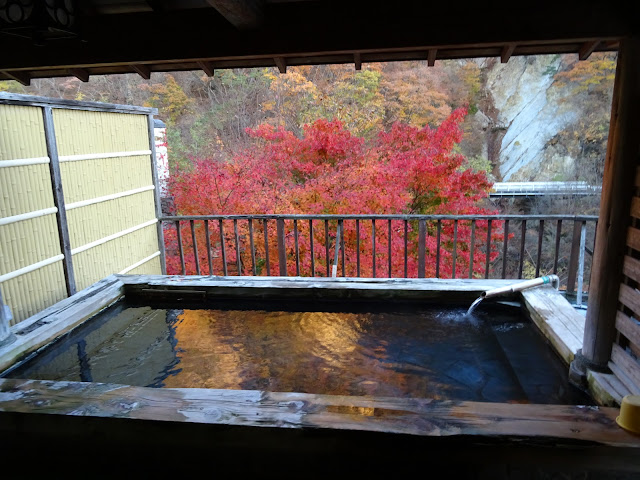
We are entering the season of fiery colors, powerful waterfalls, and hot baths with spectacular views. Grab your towel and make travel plans for the gorgeous mountains if you're in Japan. Those outside Japan will have to wait and salivate.

A friend told me that he wanted to enjoy fall in a relaxing and rustic area of Japan, where mass tourism had not changed the locals. I recommended Oigami Onsen in Numata, Gunma. Even before the pandemic, Oigami did not get much traffic despite the presence of one of the most unique and graceful waterfalls in Japan, small markets where you can meet the artists and vegetable growers, and rare festivals.  


Fukiware Falls is the name of this unusual waterfall. Ware means crack in Japanese. The river suddenly plunges into a 7-meter-deep and 30-meter-wide crack in the riverbed.  This river, bursting with colors in fall, was designated as a natural heritage spot for its beauty, and the waterfall is listed as one of Japan's one hundred top waterfalls.     

Walking and hiking trails of various difficulty levels (nothing particularly strenuous) and a small bridge take visitors to numerous breathtaking viewpoints. The river changes color depending on the angle of your view, sunlight, and water depth.
The path to the the trail heading to the falls leads through a small market evocative of Japan's countryside fifty years or so ago. The aromas of roasted salted and bamboo-skewered river fish, baked sweet potatoes, and hot amazake waft along the walkway. Traditional woven baskets, wooden dolls, and antiques are on sale, as are various wild mushrooms that might have been gathered that morning in the nearby mountains.


The main street (it is tiny) with hotels and ryokans in Oigami Onsen is a six-minute drive from Fukiware Falls. One can walk, as well. The accommodations in Oigami tend to be along the side of the river. Some are closed. Sleepy Oigami Onsen is far off the golden route of tourism in Japan. Walking along the small-town streets and the riverside are cures for stress. You'll discover another small market, tiny shrines and temples, and a mischievous supernatural being with a giant nose. His name is Tengu.


During our short sojourn in Oigami, we stayed at the mid-range Yamaguchiya Hotel. Built on the rim of a high riverbank, views from the public hot bath and most of the rooms were picturesque. Ingredients for dinner and breakfast meals were mostly locally procured fish, mushrooms, pickles, and vegetables. The building could use a bit more maintenance, but since this area of Japan does not get many tourists, probably a large number of businesses in the area are just holding on. The hotel's highlights were soaking in the bath while enjoying a wide view of rivers, cliffs, and autumn leaves. And the service provided in this mid-range hotel was as fine as that shown to guests at first-class hotels.


During one of our walks through the small town, we discovered a 108.22 m (355 ft) snake. It was holding bottles of local sake in its mouth. This snake is the one that the Guinness Book of World Records had certified as the longest festival snake in the world.


Legend has it that the waterfall was discovered by someone who saw a giant snake in the river. One of Nemuta city's webpages gives the following information:

"On May 3rd, a giant snake float weighing two tons and stretching to a length of 108 meters is brought out from its holding place at the Akagi shrine. On the 7th and 8th, 200 participants in the festival hoist the snake into the air and parade it around the streets. Adventurous souls are always welcome to join in."

I recommend Oigami Onsen to all readers seeking a relaxing time in a sleepy town surrounded by the earthy fiery colors of the Japanese autumn.